

Glucosamine for Dogs: What the Research Says, and the Green Lipped Mussel Alternative
Glucosamine is one of the best-known joint supplement ingredients for dogs. Antinol® does not contain it. Here is what glucosamine and chondroitin are, what the published research says about them, and why Antinol® is built on green lipped mussel instead.
See the alternative ›In short
Glucosamine and chondroitin are widely used in joint supplements for dogs, but the published evidence for them is weak: in a 2022 review of the research in dogs and cats, eight of the nine glucosamine-chondroitin trials analysed found no measurable effect. Antinol® takes a different approach, with PCSO-524®, a marine lipid extract from New Zealand green lipped mussels.
What Is Glucosamine for Dogs?
Glucosamine is an amino sugar found naturally in the body, including in cartilage. In supplements for dogs, it is usually made from shellfish shells. It is often combined with chondroitin, also found in cartilage and usually sourced from animal cartilage. Products differ in the form they use and in the levels of glucosamine they contain per serving.
Glucosamine sulphate or glucosamine HCl?
These are the two main forms on supplement labels for dogs: glucosamine sulphate, also spelt sulfate, and glucosamine hydrochloride (HCl). Both are forms of the same compound.
Chondroitin for dogs
Chondroitin is usually sold as chondroitin sulphate (or sulfate), most often in combination with glucosamine. This is why most of the research looks at the two together.
Glucosamine and Chondroitin for Dogs: What the Research Says
Glucosamine and chondroitin have been studied in dogs for many years. Reviews of this research have found the evidence for them to be weak.
2012: a systematic review
A review of joint supplement trials across species found the evidence for most of the products studied to be poor. (1)
2022: a systematic review and meta-analysis
Of the nine glucosamine-chondroitin trials analysed in dogs and cats, eight found no measurable effect. The authors concluded that these products should no longer be recommended for the use studied. (2)
8 of 9 trials analysed found no measurable effect
(1) Vandeweerd JM, Coisnon C, Clegg P, et al. Systematic review of efficacy of nutraceuticals to alleviate clinical signs of osteoarthritis. J Vet Intern Med. 2012;26(3):448-456.
(2) Barbeau-Grégoire M, Otis C, Cournoyer A, et al. A 2022 systematic review and meta-analysis of enriched therapeutic diets and nutraceuticals in canine and feline osteoarthritis. Int J Mol Sci. 2022;23(18):10384.
Glucosamine vs Green Lipped Mussel: A Different Approach
Antinol® was built on a different ingredient. Rather than glucosamine, every capsule contains PCSO-524®, a marine lipid extract from New Zealand green lipped mussels.
| Glucosamine | PCSO-524® (green lipped mussel) | |
|---|---|---|
| What it is | An amino sugar | A marine lipid extract |
| Usual source | Shellfish shells | New Zealand green lipped mussels (Perna canaliculus) |
| What it provides | Glucosamine | Over 90 naturally occurring fatty acids, including the omega-3s EPA, DHA and ETA |
| In Antinol® | Not included | 50mg in every capsule |

Moving from a Glucosamine Supplement to Antinol®
If your dog already takes a glucosamine supplement, you can start Antinol® while they are still on it. Begin with the 15-day loading period, when the daily amount is doubled, then move to the everyday amount set by your dog's weight.
How much Antinol® does my dog need? ›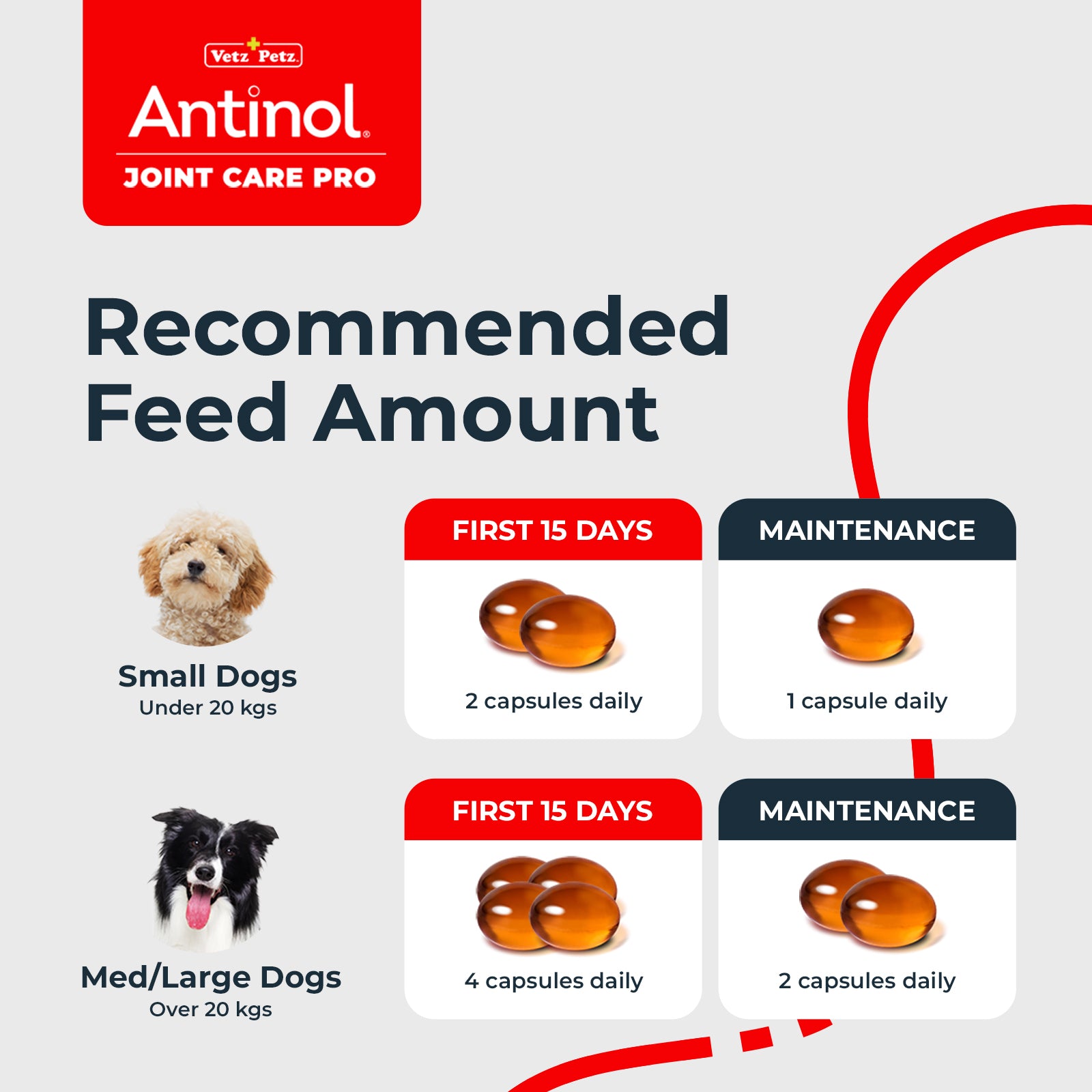
FAQ's - Glucosamine for Dogs: Your Questions Answered
-
Does Antinol® contain glucosamine?
No. Antinol® contains PCSO-524®, olive oil, vitamin E, plant-based glycerin and bovine gelatin, and no glucosamine or chondroitin.
-
Can I give glucosamine and Antinol® together?
Yes. Antinol® can be given alongside other supplements, including glucosamine and chondroitin sulfate products, except those rich in omega-6.
-
Is glucosamine the same as green lipped mussel?
No. Green lipped mussel is a shellfish, and glucosamine is a single compound, often made from shellfish shells. Antinol® uses PCSO-524®, the lipid extract of the green lipped mussel, not glucosamine.
-
Why is Antinol® built on green lipped mussel rather than glucosamine?
Antinol®’s position is that there is no evidence supporting the use of glucosamine and chondroitin in dogs and cats, so the formula was built around PCSO-524® from New Zealand green lipped mussels instead.