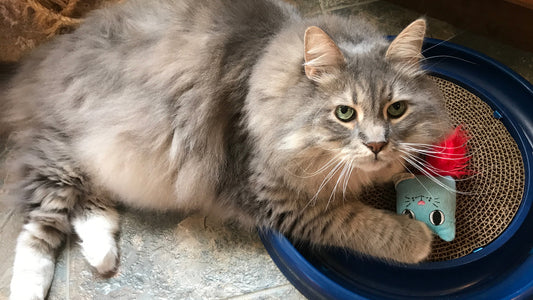
Looking After an Older Cat: A Practical Senior Cat Care Guide
Are you ready to open your heart to a senior cat? Check out all the best reasons to adopt an older cat and top tips to keep them fit and healthy.

Cats are considered senior from around seven years old, and many go on to live well into their teens. That is a long stretch of life in which their needs quietly change. This guide covers what changes with age, and the practical adjustments that make an older cat's life easier: vet checks, diet, joint care, grooming and getting around the house.
What age is a cat considered senior?

Cats are generally considered senior from seven years old, and geriatric from around fifteen. Those are broad markers rather than hard lines: an active nine-year-old and a quiet nine-year-old can be at quite different stages.
Cats do most of their maturing in the first two years, then age gradually from there. A 2014 study put average life expectancy at around fourteen years, and plenty of cats live well beyond that. In practice, a cat you take on at seven may still have a decade ahead of them.
What matters is less the number than what comes with it. From about seven, most cats benefit from a change of diet, more frequent vet checks and a few adjustments around the house.
How an older cat changes with age
Older cats slow down, but slowing down is rarely the whole story. Cats are practised at hiding discomfort, and much of what looks like a change in personality is a change in what feels comfortable.
Most of the shifts are gradual. Your cat starts using the arm of the sofa as a staircase to the windowsill. They stop sleeping on the top of the wardrobe. Their coat looks slightly less immaculate than it used to. None of these are dramatic on their own, and it is easy to notice them only in hindsight.
The table below covers the changes worth paying attention to, and which of them are worth a conversation with your vet.
|
What you notice |
What it may relate to |
What to do |
|
Jumping less, or hesitating before a jump |
Joint comfort |
Add steps or ramps, mention it at the next vet visit |
|
Sleeping in new, lower-down spots |
Difficulty reaching old favourites |
Move bedding to accessible places |
|
Coat looking unkempt or matted |
Reduced flexibility for self-grooming |
Regular gentle grooming sessions |
|
Missing the litter tray |
Tray sides too high, or a health change |
Low-sided tray, and speak to your vet |
|
Eating less, or drinking noticeably more |
Possible kidney, thyroid or dental change |
Contact your vet |
|
Less interaction, hiding more |
Discomfort, sight or hearing change |
Contact your vet |
Any sudden change in appetite, drinking, weight or behaviour is worth a call to your vet rather than a wait-and-see.
How to care for a senior cat
Regular vet checks
A senior cat has already done all its developing. They've done the crazy kitten bit, and they're over the moody teenager phase. Their personality is fully formed. They know their own minds and what they like. There are no surprises with a senior cat...well, not often.
The right diet
Most older cats are already litter trained. Even if they've not lived in a home before, cats are naturally pretty clean and will quickly pick up litter training in the rescue centre. Kittens usually take much longer, and there's way more mess and frustration with all the accidents.
Supporting their joints
Joint change is common in older cats and easy to miss, because cats rarely limp in an obvious way. It shows up instead as a cat who takes the long route to the windowsill, hesitates before jumping down, or has stopped going upstairs.
Practical adjustments help most: steps up to favourite spots, bedding at floor level, food and water that do not require a climb, and a warm place to rest. A daily joint supplement is one way to support the joint health of a healthy older cat as part of that routine.
Antinol Joint Care Pro for Cats is a 100% natural daily supplement for joint, skin and coat health, formulated around PCSO-524, a marine lipid extract from New Zealand green-lipped mussel. Every order is covered by our 60-day money-back guarantee.
Making the home easier to navigate
The teething phase for a kitten can be pretty painful for all involved. They have a natural urge to bite and gnaw on things, from toys to furniture and your hand. Senior cats are over this phase, and generally they'll only bite as a last resort, not just for fun!
Litter tray and toileting
A cat who has been reliable for years and starts missing the tray is usually telling you something High sides become harder to step over, a tray upstairs becomes a longer journey, and a covered tray can be awkward to turn around in.
Switching to a low-sided, open tray and adding a second one on the ground floor solves the problem more often than not. If it does not, or if the change came on suddenly, speak to your vet, as a change in toileting can also be an early sign of a kidney or urinary issue.
Senior cat care checklist by age
What your cat needs changes as they move through their senior years. This is a general guide, not a substitute for your vet's advice.
|
Age |
Life stage |
Vet checks |
What to focus on |
|
7-10 years |
Mature |
Annually |
Switch to a senior diet, start watching weight and mobility |
|
11-14 years |
Senior |
Every 6 months |
Joint comfort, dental checks, monitor drinking and appetite |
|
15+ years |
Geriatric |
Every 6 months, or as advised |
Easy access to litter, food and warmth; grooming help; close monitoring |
-
Regular vet checks
Keep on top of your older cat's vaccinations and parasite treatments to keep them in tip-top condition—but also have a regular check-up of their overall health. Your vet will check for joint stiffness and dental decay. They might also run blood tests to check their overall health, but in particular to keep an eye on kidney function, which commonly declines with age.
-
The right diet
When a cat reaches 7, their nutritional needs change, and they should be on a senior cat diet. These are specially designed to support your cat as they age. Look for a diet containing high-quality protein that's packed with antioxidants and has controlled mineral levels to support your cat's kidneys and urinary tract health. If you notice your cat is eating less or drinking lots, get in touch with your vet, as it could be a sign of kidney, urinary, or thyroid problems.

-
Support their joint health
It is estimated that 90% of cats over the age of 12 have signs of joint stiffness. Looking after their joints ensures they can live a happy, active life. Adding a high-quality, clinically proven joint supplement to their daily routine will support their lifelong joint health—keeping a spring in their step.
-
Pamper them
As cats age, grooming themselves can get difficult. Older cats often can't twist their bodies enough or get in the right position to keep themselves perfectly preened. Pampering them with a grooming session will keep their coat healthy and is a fabulous bonding activity for the two of you.
-
Climbing aids
Cats love to be up high, but as they get older, it's harder for them to jump up or climb down. Consider an easy-to-access cat tree with ramps, or perhaps move some furniture around to help them reach their favourite spot.
When to call the vet
Older cats warrant a lower threshold for picking up the phone than younger ones. Contact your vet if you notice:
-
A noticeable increase in drinking or urinating.
-
Weight loss, even where appetite seems normal.
-
Eating less, dropping food, or turning away from food they used to enjoy.
-
Bad breath, drooling, or pawing at the mouth.
-
A sudden change in how much they move, jump or interact.
-
Any change in toileting that is not explained by the tray itself.
Twice-yearly check-ups from around eleven give your vet a chance to pick up gradual changes that are difficult to see day to day. Ask about blood tests to monitor kidney and thyroid function, both of which commonly change with age.
Thinking of adopting a senior cat?
Older cats are consistently overlooked in favour of kittens, and it can take an adult cat considerably longer to find a home. That is a shame, because the case for a senior cat is a strong one: their personality is already formed, they are almost always litter trained, they are past the teething and whirlwind stages, and they tend to be content with a warm lap and a quiet afternoon.
Adoption fees vary by charity and typically sit around £80, which goes back into the rescue's work. If you are considering it, start with the RSPCA or Cats Protection, or search for a rescue near you.
Everything in this guide applies from the day they arrive.
Where can I adopt a senior cat?
 Visit your local animal rescue if you have space in your home and heart for a senior cat looking for love.
Adoption fees vary, but you can expect to pay around £80, which will help support the work the charity does, protecting dogs and cats and ensuring they are safe and healthy.
Visit www.rspca.org.uk, www.cats.org.uk, or search for “UK cat rescue near me” to find your new feline friend!
Frequently asked questions
-
What age is a cat considered senior?
Cats are generally considered senior from seven years old, and geriatric from around fifteen. These are broad markers rather than fixed thresholds, and an individual cat's condition matters more than their birthday. Most cats benefit from a senior diet and more frequent vet checks from around seven.
-
How often should a senior cat see the vet?
Once a year from seven, and every six months from around eleven. Older cats change gradually, and twice-yearly checks give your vet a chance to spot shifts in weight, teeth, joints and kidney function that are hard to notice at home.
-
What should I feed an older cat?
A senior formula from around seven. These are typically adjusted for protein quality, calorie density and mineral levels. If your cat is eating less, losing weight or drinking noticeably more than usual, speak to your vet before changing their food, as those can be signs of an underlying change.
-
How can I tell if my cat's joints are uncomfortable?
Cats rarely limp in an obvious way. It tends to show as a cat who takes the long route up to a favourite spot, hesitates before jumping down, has stopped using the stairs, or sleeps somewhere lower than they used to. A coat that looks less well kept can also point to reduced flexibility.
-
Why is my old cat missing the litter tray?
Usually because the tray has become harder to use. High sides, a covered design or a tray on another floor all make a difference to an older cat. A low-sided open tray on the ground floor solves it in many cases. If the change was sudden, or the new tray does not help, contact your vet.
-
Do senior cats need grooming help?
Often, yes. Older cats find it harder to twist into the positions self-grooming requires, so coats can become unkempt or matted, particularly along the back and base of the tail. A short, regular brushing session keeps the coat in order and gives you a chance to notice lumps, sore spots or weight changes early.
-
How long do cats live?
A 2014 study put average life expectancy at around fourteen years, and many cats live longer than that. Indoor cats generally live longer than cats with outdoor access. A cat adopted at seven may well have another decade ahead of them.