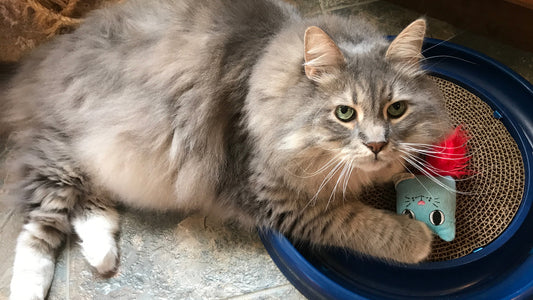
What temperature is too hot for cats? 7 tips to keep your cat cool
As temperatures are hotting up, how do you know if your cat is too hot? And how do you keep them cool and safe? Learn how to help your cat handle summer.

Your cat looks like the picture of tranquillity, stretched out, basking in the sun. All cats love to sunbathe, but with the summer temperatures hotting up, how hot is too hot for cats, and how can you keep them super cool?
Cats are comfortable outdoors between 5°C and 30°C. From 35°C upwards they struggle to regulate their body heat and are at risk of hyperthermia. Indoors, aim to keep the temperature at or below 25°C. A cat whose internal temperature passes 40°C is in heatstroke and needs a vet straight away.
What temperature is too hot for cats?
In the UK we’re not well adapted to extreme weather, but with temperatures rising, we are seeing hotter summers.
Your furry friend is pretty happy if the outdoor temperature is between 5℃ - 30℃. Once the temperature rises to 35℃ and above, they might struggle. If they can't control their body heat, they risk hyperthermia or heatstroke. Although they love to laze in the sun, they can quickly get several degrees warmer than the air temperature as they soak up the rays - so ensuring your cat stays cool is vital in the summer heat.
|
Temperature |
What it means for your cat |
|
5°C - 30°C |
Comfortable range |
|
30°C - 35°C |
Starting to feel warm - monitor closely |
|
35°C + |
Risk of overheating - take action |
|
40°C + |
Heatstroke threshold - contact your vet immediately |
What room temperature is too hot for cats?
In the summer, it's hard to keep the house cool, especially if you don't have air conditioning. Try to keep the indoor temperature around 25℃ if it's super hot outside. Any higher and your cat may begin to struggle, especially kittens, long-haired or brachycephalic cats.
Use fans, open windows, keep curtains closed - do everything you can to keep the house cool for your cat
Humidity matters as much as the number on the thermometer. Cats cool themselves largely through evaporation, from grooming saliva on their coat and from the pads of their paws. When the air is damp that evaporation slows down, and a humid 28°C is harder on your cat than a dry 30°C. Moving air is what helps: a fan, or an open window on either side of a room, does more than a closed room at the same temperature.
Nights are worth planning for too. Upstairs rooms hold the day's heat long after sunset, and a cat that sleeps on a bed in a south-facing bedroom may be spending the warmest eight hours of the day in the warmest room of the house. Leave a cooler downstairs spot available, ideally on tile or stone, and let your cat choose.
Should you keep your cat indoors in hot weather?
Not necessarily, and not all day. A cat with access to a shaded garden will often regulate itself better than a cat shut in a warm flat, because it can move around to find the temperature it wants. What matters is which hours it is outside, and what it finds when it gets there.
The hours between 11am and 4pm are the ones to restrict. That is when the sun is highest, when paving and decking are hottest underfoot, and when there is least shade to be found. Encouraging your cat to stay in over that window, then letting it out again in the late afternoon, tends to work better than keeping it in from morning to night.
If your cat does go out, check the garden offers what it needs: deep shade that lasts through the afternoon, not just the patch under a fence that disappears by noon, and a bowl of water in the shade that you top up. A shed or greenhouse your cat can slip into is worth checking too, as both become dangerously hot and a cat shut inside one cannot get out.
Some cats should stay in when it is above 30°C regardless: kittens, older cats, flat-faced breeds and white or light-coloured cats, for the reasons set out below.
How do cats cool themselves off?
Being even more lazy than usual is actually part of their master-cooling-plan. Cats conserve energy when it's hot...by doing nothing. So don't encourage them to play too much. Let them doze.
If they're not stretched out snoozing, they're likely to be grooming themselves. The saliva on their coat evaporates, keeping them cool.
7 tips to keep your cat cool in hot weather.
Cats' sweat glands are in their paws. If you notice them leaving paw prints as they walk, they're hot. Help them to keep cool with these summer survival tips.
1. Plenty of water
Even on a normal day, cats should have access to one more water bowl than the number of cats in the house. In the warm weather, make sure there are plenty of places for them to drink. Keep their bowls topped up and cool. Cats love to drink from glasses - fill a glass right to the top and pop it near their favourite spot, and they're almost guaranteed to drink more! Consider buying a cat drinking fountain - cats love running water and it’s safer than leaving a tap dripping! You can find them in most good pet stores.
2. Make shade
Whether they're indoor or outdoor cats, getting away from the sun is vital to help them stay cool. Hang up a sheet as a makeshift canopy, or pop some old boxes on their side. Make a shaded and cool spot where they can escape from the glaring sun.
3. Ice, ice, baby!
Pop ice cubes in your cat's water. Or, if they're feeling playful, let them bat some ice cubes around the floor for a fun but cooling game!
4. Give them a fan
They might not appreciate a fan blasting directly at them, but if you don't have air conditioning, a fan is the next best thing. Place it near their favourite snooze spot to circulate the air.
5. Cooling groom
Getting rid of excess fur will help your cat stay cool, especially if they're long-haired. Keep them groomed, and use an appropriate brush or tool to remove old fur. In really hot weather, stroke them with a cool, damp cloth. This acts like their saliva when they groom themselves and helps them maintain a normal body temperature.
6. Cooling mats or ice packs
You can buy special pet cooling mats to pop in their bed or wherever they choose to snooze. They help draw away heat and keep your kitten chilled. You can also use ice packs that you'd use for your picnic. Make sure they're not gel ones that claws could damage, and never let them lie directly on them. Keep them covered with a sheet or cloth.
7. Sunscreen
We cover ourselves with it, but if your cat is light-coloured, keep their vulnerable areas covered with pet-safe sun cream. Their noses and the tips of their ears are the most likely to get burnt. White cats, in particular, are prone to burning, and skin cancer of the ears is common - so keep them protected.
How to cool a cat down quickly
Cooling cats is mostly about giving them options: somewhere colder to lie, more water than they think they need, and less reason to move around. These seven do most of the work.
The seven tips above are about stopping a cat from overheating in the first place. If yours is already too hot right now, this is the order to work in.
-
Move your cat to the coolest room in the house, ideally one with a tiled or stone floor, and open a window or put a fan on to get the air moving.
-
Offer cool water. Do not force it. A cat that is alert will usually drink if the bowl is put in front of it.
-
Dampen a cloth with cool water and stroke it over the coat, working from the head backwards. This mimics what your cat does when it grooms itself, and the evaporation does the cooling.
-
Do not use ice water or ice packs directly against the skin. Cooling too fast constricts the blood vessels at the surface and slows heat loss down rather than speeding it up.
-
Do not cover your cat with a wet towel. A towel laid over the body traps heat underneath instead of letting it escape.
Give it a few minutes. If your cat settles, breathing slows and it starts moving normally again, it was heat exhaustion and you caught it in time. If nothing improves, or if any of the heatstroke signs below appear, call your vet.
How to recognise heat exhaustion and heatstroke
Heat exhaustion is when your cat's body is showing early signs of stress due to the extreme temperatures. Heat stroke is when your cat's body is overwhelmed by the temperature stress and can't thermoregulate - failing to keep the body's internal temperature below 40℃.
Early signs of heat exhaustion in cats include
- Restlessness
- Panting
- Drooling
- Sweating from paws
- Excessive grooming
If their temperature gets too high, symptoms of heatstroke in cats include
- Vomiting
- Lethargy
- Red tongue and mouth
- Rapid breathing
- Fast pulse
If left untreated, heat stroke can result in collapse, seizures, and even death.
Which cats are most at risk in hot weather?
Every cat feels the heat, but some reach the point of struggling well before others. If yours is on this list, apply everything above sooner and more carefully than you would for a healthy adult cat.
- Kittens and older cats. Both regulate their temperature less efficiently than a cat in its prime, and older cats are often slower to move themselves somewhere cooler.
- Flat-faced breeds. Persians, Exotic Shorthairs and British Shorthairs have shortened airways, which makes the panting and rapid breathing a cat falls back on in extreme heat far less effective.
- Long-haired cats. A thick coat holds heat in. Regular grooming through the summer removes the dead undercoat that traps warm air against the skin.
- Overweight cats. Extra body fat insulates, so an overweight cat is working harder to shed heat and tires sooner in warm weather.
- White and light-coloured cats. The risk here is sunburn rather than overheating. Noses and ear tips burn easily, and ear damage is common in white cats, so keep the exposed areas covered with a pet-safe sun cream.
Cats with an existing health condition. If your cat is being treated for anything, or is on medication, ask your vet what hot weather means in their case before the first heatwave rather than during it.
What to do if your cat is too hot
If you think your cat is showing signs of heatstroke, there are things you can do to help. If their condition deteriorates, get medical help from your vet.
- Move them to a cool, well-ventilated room.
- Offer them cool water to drink, if they are alert enough
- Stroke them gently with a cool, damp towel. Don't cover their body as this may trap the heat underneath.
- If they are really struggling, wet their coat with cool water and get them to a vet as quickly as possible. You might transport them with a cool pack underneath them or even a bag o frozen peas wrapped in a towel between their legs.
Summer is a good time to pay attention to how your cat moves. If you notice they're a little slower to get up, less keen to jump, or spending more time resting than usual, it's worth keeping an eye on their joint health - especially as they get older. Antinol Joint Care Pro is a vet-validated cat joint supplements formulated with PCSO-524 to help maintain healthy joints in cats at all life stages.
We’d love to see your furry friend enjoying the sun! Send as a snap to EMAIL!
Frequently asked questions
-
What temperature is too hot for cats?
Cats are comfortable between 5°C and 30°C. Above 35°C they may struggle to regulate their body heat and risk heatstroke. Indoors, aim to keep the temperature below 25°C in hot weather.
-
What room temperature is too hot for cats?
Try to keep indoor temperatures around 25°C in summer. Kittens, long-haired breeds, and brachycephalic cats are particularly sensitive to heat and may struggle sooner.
-
How do cats cool themselves down?
Cats cool themselves by resting to conserve energy, and by grooming-saliva on their coat evaporates and helps lower their body temperature. Their sweat glands are in their paws.
-
What are the signs of heatstroke in cats?
Early signs include restlessness, panting, drooling, and excessive grooming. If untreated, symptoms escalate to vomiting, lethargy, rapid breathing, and a fast pulse. Contact your vet immediately if you suspect heatstroke.
-
What temperature is too hot for cats outside?
Above 35°C, outdoor conditions become risky for any cat. Between 30°C and 35°C, restrict access during the middle of the day and make sure there is deep shade and water available in the garden. Below 30°C, most healthy adult cats manage well outdoors and will find their own cool spot.
-
At what temperature should cats be kept indoors?
There is no single cut-off. As a working rule, restrict outdoor access between 11am and 4pm once it passes 30°C, and keep kittens, older cats, flat-faced breeds and white cats in entirely above that point.